
- All
- Product Name
- Product Keyword
- Product Model
- Product Summary
- Product Description
- Multi Field Search
Views: 0 Author: Site Editor Publish Time: 2026-02-28 Origin: Site


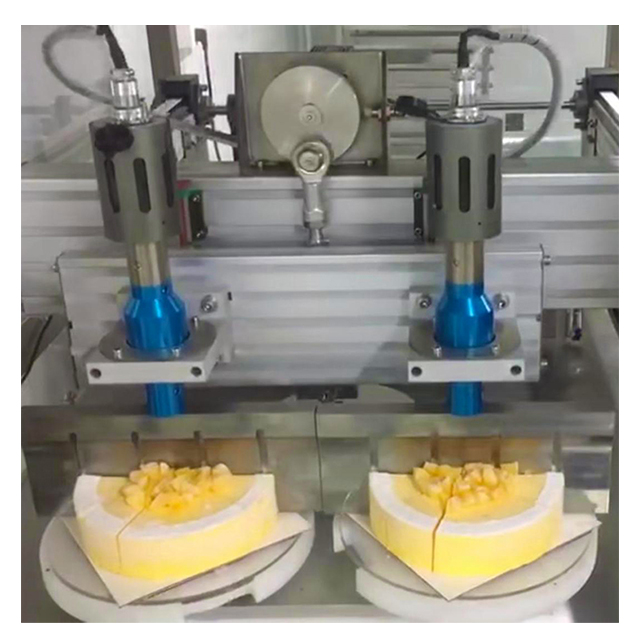
In the modern baking and food industry, the Ultrasonic Cake Cutter has become a core cutting device for high-value-added products such as cakes, mousses, crepe cakes, and cheesecakes. Compared to traditional mechanical cutters, ultrasonic cutting offers advantages such as no sticking, clean cuts, and reduced waste.
However, many factories overlook a crucial issue—the correctness of maintenance and cleaning methods directly determines the equipment's lifespan and cutting stability. This article will systematically explain the use of ultrasonic food cutters from three aspects: cleaning, upkeep, and maintenance.
Ⅰ. Why must ultrasonic cutting machines be cleaned properly?
Ultrasonic cutting relies on high-frequency vibration to achieve low-resistance cutting. Inadequate cleaning can lead to:
• decreased ultrasonic amplitude.
• burrs on the cut surface.
• reduced blade life.
Ⅱ. Daily Cleaning Standard Operating Procedure (Step-by-Step)
Step 1: Turn off the power and disconnect the vibration system
Disconnect the main power supply and wait for the equipment to completely stop vibrating, ensuring there is no residual power.
Caution: Do not disassemble the blades while the equipment is powered on.
Step 2: Disassembling the Ultrasonic Blade
Ultrasonic blades are typically made of titanium alloy, such as Ultrasonic Blades.
Note during disassembly: Use a dedicated wrench, avoid impacting the blade, and do not forcibly twist the transducer connection.
Step 3: Warm Water Cleaning (Avoid High Temperatures)
It is recommended to use warm water (40–50℃) and a food-grade neutral detergent.
Avoid direct impact from strong acids or alkalis, metal brushes, or high-pressure steam on the vibrating nodes, as this may affect the ultrasonic resonance frequency.
Step 4: Dry thoroughly
Wipe dry with a lint-free cloth or let it air dry naturally. Do not reinstall while wet, as residual moisture will affect vibration efficiency.
Ⅲ. Regular maintenance and inspection of key items
1. Check the blade wear.
If there is increased cutting resistance, uneven cut, or abnormal noise, check if the blade edge is deformed.
2. Check for loose transducer connections
The core components of an ultrasonic system include: the generator, the transducer, and the amplitude transformer. Loose connections can lead to unstable amplitude when using a manual ultrasonic cutter or production line equipment such as an inline vertical slicer.
3. Check if the amplitude output is normal
Determine the amplitude output by observing the cutting time, whether the cake shows stringy texture, and whether the equipment temperature rise is abnormal.
Ⅳ. How to extend the lifespan of ultrasonic blades?
• Avoid vibration without load: Vibration without load accelerates fatigue.
• Do not cut hard foreign objects: such as metal decorations, plastic cards, etc.
• Regularly calibrate the amplitude: Different cake densities require different amplitude parameters.
Conclusion
Ultrasonic cake cutters are not "maintenance-free devices." Only by establishing a systematic cleaning process and periodic maintenance mechanism can their high precision and efficiency be fully realized.
If you are currently using ultrasonic cutting equipment, it is recommended that you immediately check whether your current maintenance procedures meet the standards. If you plan to introduce an automated ultrasonic cutting system, understanding the maintenance specifications in advance is equally important.
